Wednesday, February 06, 2008

I am inspired! (and well done Missouri...)

via Dowd column today...
"I think we should never be derisive about somebody who has the ability to inspire," Senator [Claire] McCaskill told David Gregory on MSNBC on Tuesday. "You know, we've had some dark days in this democracy over the last seven years, and today the sun is out. It is shining brightly. I watch these kids, these old and young, these black and white, 20,000 of them, pour into our dome in St. Louis Saturday night, and they feel good about being an American right now. And I think that's something that we have to capture."
Inspiration matters! It is scary to be inspired. I am inspired! Run, Obama, run!

On to Kansas, Louisiana, Nebraska, Washington and even the Virgin Islands!

Friday, February 01, 2008

"Malaria and How to Beat It"

The debate on giving away free malaria nets (and other health interventions) continues in The Economist. Now the WHO is backing the drive to kill the notion that paying a small amount makes a greater impact.

I am a bit confused in my own logic on this one. The Economist saying give it away, while I am intuitively feeling like "free is more effective" still ignores a few key points. Maybe the simple lesson is summed up best by hwig, a commenter on the article...
Giving out free nets is fine but it should be accompanied by a strong program of education otherwise they will be misused in exactly the way described at the beginning of the article.
Is that right?

Update March 24, 2008: A few more comments on the matter from the PSD blog, which has a link to the WRI post that has commentary on the issue.

Thursday, January 31, 2008

Jenna Bush in 2049!

Very well put, Mr. Kristof!
Mrs. Clinton has proven herself an excellent senator, and presumably would make a superior president. Yet...28 years...two families! That needn’t be decisive, but it’s too important to be ignored.

Nobody loves Kazakhstan more than me, but...

But I got to say, Bill Clinton is trying to make me really dislike him.

Read: An Ex-President, a Mining Deal and a Big Donor.

Is Clinton doing it for the good of his foundation? For the good of Kazakhstan? Sorry, this sounds very, very fishy.

And what is with the timing of this story? I saw nothing related to current events and actually caught the story when it popped up on my Google mail news feed.

Monday, January 28, 2008

Tuesday is a HUGE day!

I can't recall being excited about a politician, until May. I was disappointed to read the NYT endorsement of Clinton, but was far from convinced.
Mr. Obama and Mrs. Clinton would both help restore America's global image, to which President Bush has done so much grievous harm. They are committed to changing America's role in the world, not just its image.
...
On the major issues, there is no real gulf separating the two.
It goes on to say how they are impressed with Clinton's experience and concludes that she's more qualified/best choice.

OK. That's one opinion, but no policy differences of note and generally an acceptance that "experience" wins the day.

I will let three people express the way I would respond...

Bryant Jones, a 25-year-old, white, normally Republican voter, quoted today in Roger Cohen's column:
I'm 25 and for my entire life a Bush or a Clinton has been in the executive office, either as vice-president or president. The United States is not about dynasties.
Not a usual for me, but William Kristol on today's op-ed page:
Right now, Hillary Clinton is ahead in the polls in almost all the big states voting. She is a tough and capable campaigner, and she may be able to hold on to those leads. But it is now clear that putting her in the White House brings a hyperactive Bill back in with her. Who needs it? Liberals and Democrats can get basically the same policies without the Clinton baggage, and in choosing Obama, they can nominate a more electable candidate.
Most importantly, Toni Morrison, as quoted from a letter printed in the NYT:
In addition to keen intelligence, integrity and a rare authenticity, you exhibit something that has nothing to do with age, experience, race or gender and something I don't see in other candidates. That something is a creative imagination which coupled with brilliance equals wisdom. It is too bad if we associate it only with gray hair and old age. Or if we call searing vision naivete. Or if we believe cunning is insight. Or if we settle for finessing cures tailored for each ravaged tree in the forest while ignoring the poisonous landscape that feeds and surrounds it.

Wisdom is a gift; you can't train for it, inherit it, learn it in a class, or earn it in the workplace -- that access can foster the acquisition of knowledge, but not wisdom.
And I was not convinced by Mr. Krugman comparing Obama to Clinton in 1992. Huge difference.

I'm daring to be excited!

Tuesday, January 15, 2008

Not Enough Innocents Abroad

Last week's opinion on Peace Corps, Too Many Innocents Abroad brings up some old questions about the value of the organization.

I don't think that the article was as anti-Peace Corps as many responses I read seemed to imply. It was asking for some self-evaluation, which can't be bad.

Peace Corps isn't a development organization (and shouldn't be compared to one). What kind of organization it is...up for debate. I love it and sometimes hate it (for many of the reasons mentioned in the article). But I think its best strength is as cultural exchange organization. (Well covered in the letters that followed and the response from Senator Chris Dodd.) It will keep getting support because a lot of people, especially me, know that this is valuable. Impossilbe to measure, but also impossible to deny for anyone who had gone through it. I was so humbled by what I learned about being an "outsider" from my two years in Russia as a volunteer. It was invaluable for me, even though there are a lot of things I might want to change about the old PC. I considered leaving after a year and would have, but really thought the people I worked with valued my contribution.

As a policy suggestion, rather than just recruit more older PCVs, we need Peace Corps in Saudi Arabia, Iran and Pakistan, if we could convince those governments of the value of exchange and solicit the invitations needed. Nothing would be better for "peace" than dumping some snot-nosed 25-year-olds (like I was) into a really odd situation. It would be tough to find valuable, semi-structured, sites, but I am sure there is something Americans could be good for in these well-educated countries. I still maintain that cultural exchange and cooperation on "soft" issues like the environment was key to thawing relations with the Soviets. I can't imagine it was less scary to visit Russia in early 1980s than it would be to visit Tehran today.

Friday, December 14, 2007

Merry Green Shopping!

A NYT story dear to my confused and complex heart - A World Consumed by Guilt - it's complicated this holiday season...
So what can an unreformed consumer do in the face of green fashion that doesn’t always fit?

“Perfect doesn’t exist and we’re probably never going to get there,” said Leslie Hoffman, the executive director of Earth Pledge, a nonprofit group that promotes sustainable development and technologies. “We all make compromises every day. Making them with your eyes open instead of arbitrarily is the best piece of advice I could give.”

Wednesday, November 28, 2007

(Not) Shopping Till I'm Dropping!

My friend at Global Lab is always reminding me about neo-liberal economic principles and consumerism and he's not the only one! Today I learned (via Four Hour Work Week Blog) about some who are going the beyond the No-shopping-for-a-day! stuff, which always seems pointless to me. Some have tried no shopping for a year!

I enjoyed this little exchange on broken head phones. I wonder how long I could last in such a Compact. Of course, I know that ending shopping would end economic growth and we can do that, right, Global Lab. ;-) But it is nice to be pushed to think a bit harder about how often we run to the shop for a new set of head phones when many-a-friend probably has an extra pair. I have two extra if anyone needs a set.

Here are the rules they set up.

I also liked what a reader named liz said after reading the rules...

ah... america... where the upper class can take the higher ground by resolving to live a consumer life somewhat like the majority, who cannot afford to choose such a lifestyle choice, and publish their efforts to make themselves feel better, while arguing inane cop outs of their original decision. go for the gold team america!

OK, Liz, you are right, don't be such a little anti-american. Can't they pose the questions and dare to think a bit harder about it all? Humor us, please.

Oh yeah, and Buy(Less)!

Sunday, November 11, 2007

Attention for the "Bottom Billion"

The Bottom Billion is worth a read. In fairness, I should read the End of Poverty since I already read and have been positively provoked by The White Man's Burden (which I don't feel places me on the right, as Collier suggests, anymore than I would call Sachs a defender of the left, but that is another story for other posts).

Summaries and reviews of Collier are plentiful, here and here and here so I won't bother with that.

I think it contributes some clarity to "conditionality" in the international development discussions and the term "governance conditionality" - that which is based on broadly agreed international norms - is an area I think might gain traction in a new information-obsessed world.

The greatest contribution is his analysis of laws and charters. Clearly, no international court is in the near future, but he cites the progress - note that I stop short of calling them "successes" - of initiatives like the Kimberly Process and Extractive Industries Transparency Initiative. I would add that voluntary initiatives such as the Equator Principles, which I use a lot in my work, are re-focusing the debate on role and responsibilities in international development. There is less turning a blind eye to the indirect impacts of our actions.

I was less offended than I expected to be about his arguments for military intervention. He certainly doesn't defend the blunders of Iraq and rather tries to re-think Somalia and Rwanda and how they might have followed a scenario more like what he considers to be successful interventions like Sierra Leone.

Thursday, November 08, 2007

Still my favorite blog!


Congrats to Kedibonye Elijah, winner of the HIV essay contest, and especially to the two creators of Nata Blog. What an amazing model for getting support and sharing your stories.

C.A.R. Blog?!?

This is leap-frogging at its best! Kudos to the Humanitarian and Development Partners - Central African Republic for a Web 2.0-charged blog and intranet for Humanitarian and Development agencies. I learned about it from friend and was gutted to have missed the presentation of Tony Lanzer at the LSE. You can still see the presentation online with power point.

Everyone should learn a little bit about CAR..., but somewhat only an aid story. More on that later.

Wednesday, November 07, 2007

More on mosquito economics

To subsidize or not to subsidize, isn't that always the Economist's question? It was in Money v mosquito, asking whether the Gates Foundation and World Bank should subsidize a malaria remedy to keep the price down.

(Has anyone else noticed that when you wish to blog about something, you end of finding five more things you should read?)

Tuesday, November 06, 2007

That's Random

I am a fan of the potential of randomized trials and was pleased to read an article in the 25 Oct 2007 issue of Nature called Field Trials Aim to Tackle Poverty. The Poverty Action Lab, featured in the article, is a good resource for me, but I thought the article was a bit unfair to the "debate" over handing out malaria bed nets for free or charging. (Here's the paper for those wishing to review their development economics.) They take a swipe at Population Services International, an organization I have appreciated in many contexts, mostly as they push people (me, especially) to see aid and health programs as more than just supplying the needed goods. It also requires socil marketing to help change behavior, or so I thought.

Maybe I will spend Sunday afternoon reading this and see if I was wrong all along.

Wednesday, October 31, 2007

Add a few more voices...

It goes on... Ugandan journalist Andrew Mwenda didn't sound like he wouldn't sign up to (Red) any time soon. His talked seemed to make waves over the summer and is now online.

And I have stumbled upon Arvind Subramanian through the PSD blog's diligent monitoring of the debate.

Thursday, October 25, 2007

Social Change - The Wrong Way

I "heart" NPR. I love the way it just hits you with a voice... Here's the latest "frustrated" and "pained" voice who explains social change is going in the wrong way in Iraq.

And the letters.

Sunday, September 30, 2007

"Jetsons to the Flintstones"

Not commonly one to appreciate Mr. Friedman tone, I can't agree more with his Sunday column on 9/11 is Over.

Wednesday, September 12, 2007

Steve Biko

The BBC had a link that caught my eye - it has been 30 years since the death of Steve Biko, the South African leader of black consciousness. Seems a bit narrow as he helped me learn a lot about being conscious in general. I learned about Biko while reading My Traitor's Heart, one of my favorite books for too many reasons to name here. Highly recommended!

Monday, July 23, 2007

Design for the other 90%

(Via PSD Blog), a fantastic story and video in the NYT about the concept of design for development. I will see the exhibit at the Cooper-Hewitt Design Museum in New York, as the Design for the other 90% exhibit it is there until September 23.

Sunday, July 15, 2007

Collier joins the debate

The Sachs versus Easterly debate expands! This is good as I was beginning to think it needed some fresh insight. Paul Collier's new book, The Bottom Billion, according to the Time's Sunday Book Review last week, is a must read and a better book than either of the recent efforts of Sachs or Easterly.

The Financial Times summarizes:
So what else is needed to help countries in the bottom billion? Collier makes three suggestions: first, military intervention; second, laws, statutes and charters for improved governance; and, third, trade preferences.

Controversial, but given the debate needs some news ideas. Waiting for my copy...

Sunday, June 03, 2007

Listen to a good interview about...a lot!

(Via Paul) I listened to an interesting interview with Tim Smit, the founder of the Eden Project, on BBC's In Business (May 31, 2007). I appreciated this part (about 16:50) of the interview:
Peter Day: You think social entrepreneurs are thinking too small, don't you? This is a new or fairly new movement which has enormous possibilities.

Tim Smit: I think it's a new movement, but I think it's also a new philosophy of business and it irritates me that we define people as being social entrepreneurs when in fact our ambition should be to make all entrepreneurial activity social. The only distinction I can see between social entrepreneurship and ordinary entrepreneurship is the ultimate disposal of the surplus of profits and of course the philosophy behind the protocols of its management. But if you had a business...that was ethically sourcing its products; that was making a light a footprint as it could; that was treating its people well; that was trying to create products of social benefit or joy; after it had achieved all those things, I don't really care what it does with its surpluses or its profits.

More on the definitions follows. He cuts through some of the language that frustrates me.

He has some interesting rules he uses:
* Say good morning to 20 people before you start work.
* Read two books a year that people who know you think are outside your interest and review them for your colleagues. (A mid-year resolution, I think!)
* Make a speech once a year about why you like your work.
* You have to prepare a meal for 40 people you like working with. (Done because major decisions are made at night; "...the influences you bring to bear on your decision are wider than more narrow confines of what you might do if you just had your work hat on.")

Let's have a dinner party!

Friday, June 01, 2007

Making Money, Making a Difference?


Thanks to the Private Sector for Development blog, I read these four cases of "sustainability" about Coca Cola, McDonalds, Proctor & Gamble and General Electric. In case you hadn't noticed, they are Making Money, Making a Difference, according to the Motley Fool.

OK, P&G and GE I can read without feeling like my feathers are too ruffled. But McDonalds and Coke? I just couldn't swallow this easily. I did have to ponder: what do we do when McDonalds works with Conservation International to decrease their un-sustainable whitefish consumption from 50,000 to 32,000 tons? I suppose we do need to praise Coke for trying to support education, improve water efficiency and reduce CO2 emissions, but shouldn't their corporate responsibility work address obesity and rotten teeth, the actual externalities of their sugar infused products?

Would you like a super size fillet-o-fish (see link for content of sandwich) and coke while you ponder that sustainability report? Too much damage was done with Super Size Me to let me buy this corporate hand washing, even if done with P&G's soap that is supporting hygiene at the Bottom of the Pyramid.

Sunday, May 13, 2007

Election '08: Preliminary bet on Obama

I've done it. While this is not meant to be an overtly political blog, I find it worth sharing that I have given my first political contribution to Senator Barak Obama. I admit that I have not studied all issues to my heart's content, but I am excited by Obama's approach and maintain a slim hope that a US election with Obama on the ticket would move us a few steps away from poisonous politics and, as The Economist sums up well, flirtation with monarchy:
The dynastification of American political life is weakening America's claim to be a democratic beacon. These days political dynasties are usually associated with the young democracies of South Asia rather than mature republics. The dynastification of its political life also points to a deeper problem: the fact that America is producing a quasi-hereditary political elite, cocooned in a world of wealth and privilege and utterly divorced from most people's lives.
The tipping point (to donate) for me was the New Yorker article I read last night. Just having someone who reflects would be a hugely needed breathe of fresh air for US and global politics.

I gave my donation with reservations. I will always listen to my intellectual hero, Cornel West, who expressed some reservations about Obama's campaign announcement. I also find the myspace situation concerning, but not enough to keep me from expressing my hope for a deeper, self-reflective engagement in politics, which is what the Obama '08 campaign represents to this American living in London.

Tuesday, May 01, 2007

Peace Corps Blogs

Peace Corps Blogs - and what seemed to be a lack of them - have been an interest of mine for some time. I think one of the coolest elements of Peace Corps is what it allows Americans to learn by deeply - sometimes too deeply - integrating into another culture. Often these are very less-traveled cultures so I was pleased to see some Returned Peace Corps Volunteers have set up a site with Peace Corps blogs. Back in the day, when I did Peace Corps (Western Russia 1996-98), we had World Wise Schools, but I could never get the the buzz going with Russian students through snail mail. Blogs are World Wise Schools on drugs. There is also a podcast called Volunteer Voices. I will be going to Mongolia soon and will be busy exploring the blog impressions of Americans in the steppe.

If you look at any of these, I would love to know what you think of them.

Friday, April 20, 2007

Case for "political pillars"

Which is the greatest threat to globalisation: the protesters on the streets every time the International Monetary Fund or the World Trade Organisation meets, or globalisation's cheerleaders, who push for continued market opening while denying that the troubles surrounding globalisation are rooted in the policies they advocate?
Dani Rodrik on globalization...
Historians teach us that globalisation rests on delicate social and political pillars. The first order of business today is to strengthen these pillars, rather than to push market opening further.

Thursday, April 19, 2007

Buy (Less)

I am not opposed to the idea of donating part of the profits to help boost sales, but I haven't been a fan of (RED). There were some thoughtful comments recently on the Stanford Social Innovation Review blog. Don't miss the comments either...
What’s wrong with all of this ostensible “corporate generosity”? First, it is self-serving, further diminishing true altruism in the corporate world. We live in a society where values are threatened, and avarice and greed need to be better balanced by a sense of the greater good – the commonweal. If values erode further in the market, nonprofits and the rest of us are all in deeper trouble. Second, all of us need to understand that, in the words of Buy(Less), shopping is not a solution. We cannot consume our way to charity and to a better world. Doing good sometimes requires sacrifice, and we ought not allow ourselves to be convinced that we’ve done our part because of the color of what we use. Third, we generally don’t know how much goes to the cause and how much goes to profit for each sale or in the aggregate; there is no true transparency or accountability. What do direct and secondary benefits add up to for the corporation? Are charities being fairly compensated for those benefits? Fourth and last, we need to remember that there really is a profound difference between doing well and doing good. To the degree that we confuse the two, we substitute ourselves for the other and are diminished rather than enriched.

Check out Buy (Less).

Wednesday, April 18, 2007

Cultural literacy

I like the questions that the Cultural Literacy project at Demos is asking:
What skills do we need to read a changing world?
What are the key skills that we will need as cultures merge, meet and clash to a greater degree than ever before?
What can we learn from other disciplines and domains, like anthropology in how to approach this new environment?

I am very interested in interaction and the Cultural Literacy project gave a great link to a Wired article that discusses the dominance of English in cultural communication. One part of me wishes this wasn't the case, but when I read the article, I found myself thinking about other places, like the South Caucasus. Instead of culture going through a Russian channel in that part of the world, people are less likely to interact (Armenian, Azeri and Georgian are very different languages). I don't like the idea of having only one language hub, but do think having a few "biggies" - like the six UN languages - helps immensely. We need "hub and spoke" and "point to point" communication and we always will.

You can subscribe to the Demos projects and get regular updates through your feed reader. There must have been a real mastermind behind that site. It is truly amazing.

Coffee trade and intellectual property

The value of a brand or a manufacturing license is now far more important than a product’s physical production. Also, income from creative products (such as designs, writings or inventions) is entirely due to intangible value.

So reports the Light Years IP website, which today launched a blog on its project with Ethiopian Coffee growers. The blog will give "real-time coverage as they lead a momentous training on Intellectual Property management, bringing together fine coffee stakeholders from across Ethiopia."

This case seems to need a whole econ course. If you talk to Starbucks, the seem to think they have done a lot to help coffee and Ethiopia. If you get the other sides, Starbucks is little more than a greedy corporation. Of course, the Economist warns us of the side effects of fair trade initiatives:

Starbucks also has questions about the different standards of fairness applied by the Fair Trade brand custodians in different parts of the world. It doubts even that the strategy of the Fair Trade movement, to secure farmers a premium over the market price for their beans, is the best basic approach. Starbucks prefers a code known as the CAFE practices (Coffee and Farmer Equity), which aims to help coffee farmers develop sustainable businesses through a mixture of technical support, microfinance loans, and investment in infrastructure and community development where the farmers live.

No opinion here. But I am eager to hear a bit more from the directly affected people rather than another press release from Starbucks or an NGO working on fair trade. Perhaps the Light Years IP blog will give some insight. I will also be reading through the Poor People's Knowledge, that includes a chapter by the founders of Light Years IP. This seems like an idea worth exploring.

Wednesday, April 04, 2007

Life Along the Pipeline


This is a good article. I appreciate the balance and love the photos. (Disclaimer: Rena Effendi is a pal of mine. But she still takes really amazing photos. I learn a lot from her images.)

Friday, March 30, 2007

The Machine is Us/ing Us

Lack of Intelligent Debate

The Intelligence Squared moronic debate held on Tuesday was the greatest display of arrogance I have seen in a long, long time.

The motion, put forward: We'd be better off without religion.

My favorite part was when Rabbi Julia Neuberger was making a point about how scornful the "For" side was when Christopher Hitchens heckled her from the other side of the stage.

In reflecting after, I asked how they could pose such a provocative question and ask a self-professed liberal rabbi, an art historian and a philosopher to defend the value of religion's existence. I find this dangerous and disturbing. Neither side was convincing and after an initial interest in good debate, I just got bored. According to UK statistics, there are 41 million Christians and almost 1.6 million Muslims in the UK. There are 267,373 Jews in the UK. Not reinforcing any stereotypes there, are we?

The final vote - 57.8% For - 37.3% Against - 4.3% Don't Know - was a loss for tolerance and moderation, as well as a little gas on the fundamentalist fire. Just what we needed.

Here is The Times Religion Correspondent's post on the event and a really useful article for sparking reasoned debate.

Still my favorite blog...


The Nata Village blog remains one of my favorites. I like checking in from time to time...today I was inspired by the exchanges that are beginning with schools from North America that have picked up on this and are beginning to have their students read about Botswanna.
Despite the hardships here, kids still figure out a way to have fun. The boys in the photo are big fans of the Zebras. The Zebras are the national football (soccer) team of Botswana. Whenever the Zebras play, everyone gets excited about it and the kids show their spirit by painting their chins the team colors. We are pleased that kids in the developed world are opening their minds to the hardships of others. The teachers are doing a fantastic job of educating their students.

Tuesday, March 20, 2007

Drawing a social investment line

Today's slog through my bloglines was fruitful! The Global Development: Views from the Center blog is full of great stuff and I am still at work trying to make sense of it all.

Interesting story
about the effect of investments in companies that do bad things. The LA Times has been looking at the Gates Foundation investments. This kind of goes along with my last post on Philanthropy...how far does this socially responsible investing, buying and living actually go? Favorite quote from a related Seattle Times
article:
"It's very, very complex. Let's say I don't invest in oil companies but I do go and buy gas with my car. Let's say I don't buy gas for my car, but I use rubber tires. Where do you draw the line?"

Sunday, March 11, 2007

Philosophy on philanthropy

This Peter Singer article on giving has challenged me for years. Comments on it are very welcome!

I have been meaning to post on this since I came across another thought-provoker by Singer in December - "What Should a Billionaire Give - And what should you?" He seems to have been sparked by the New Year giving season and the huge philanthropic gesture in 2006 by Warren Buffet, who added $31 million to the Gates Foundations already healthy coffers.
Philanthropy on this scale raises many ethical questions: Why are the people who are giving doing so? Does it do any good? Should we praise them for giving so much or criticize them for not giving still more? Is it troubling that such momentous decisions are made by a few extremely wealthy individuals? And how do our judgments about them reflect on our own way of living?

Good questions, so thanks for the reminder. But I have to say, my thoughts have changed on Singer and I no longer seriously think the difference between my homemade tuna sandwich and a boozy lunch out could be the difference between a hungry and a healthy child somewhere. I still greatly appreciate his work and wrestle with his ideas, but his examples assume straight forward action and result. Giving money doesn't always save a life. Giving large amounts of money - particularly to countries with poor governance structures - can actually make new problems.

Singer's calculates that 10% of the richest families in the US could generate $404 billion giving away only a portion of their incomes. This would easily pay for the changes Jeffery Sachs has estimated the world needs to meet the Millennium Development Goals.

But is the UN the best set up to use $404 billion? What if we took all $404 billion and put it in micro-enterprise? Peacebuilding? Democratization? Capacity building? Security? Gender rights? Human rights? Education? Climate change? And those pesky incentives and disincentives created by giving will not go away.

Mercy, we all need to do more, me included, but the debate on aid effectiveness has to go beyond the idea of giving money to get rid of a problem. The fact is, we won't get a grand slam result with a grand slam philanthropic donation.

Wednesday, March 07, 2007

On importance of corporate governance...

Hopefully, I keep believing that things like transparency and good practice matter, even in places where an average citizen does not have much purchasing power.

The PSD Blog had a good post on the main reason why they felt corporate governance matters in the transitioning countries of Eastern Europe and beyond.

I certainly agree, but there is a need for some sort of critical mass that allows competition - in the good sense - to lift the bar on standards and transparency.

Not sure myself if corporate governance is outside corporate responsibility.

Tuesday, January 30, 2007

Dropping Knowledge

Well, Dropping Knowledge seems to have something for just about everyone in its quest to further "the promotion of international understanding and the promotion of art and culture."

Due to my long-time admiration of Cornel West, I was drawn to the Table of Free Voices.

100 questions - Does our wealth depend on the third world being poor? What's after capitalism? Is corporate social responsibility possible?

112 participants - Wim Wenders, Cornel West, Bianca Jagger...mmmm, what's going on? Lot's of people from all corners of the planet, many of whom I have never heard of, but they all seem to have answers and in videos!

Professor West's answer - the video - to the question of whether corporate social responsibility is possible:
There is no doubt that corporate social responsibility is possible. It’s not only possible but it’s necessary. It’s highly desirable. We have seen, in fact, corporations make significant concession to workers over the last 150 years or so in which in fact child labor laws and which in fact healthcare and other benefits do in fact take place. It has everything to do with the power and clout, the organized pressure of working people, of trade unions in work places trying to ensure that the corporate quest for profits do not take place in such a way that that quest ignores the rights of working people so that we have, in fact, seen corporate social responsibility at work. Unfortunately in the last 30 years, workers rights have been attenuated, working workers power have been cut; and corporate social responsibility cannot be talked about without, in fact, significant worker organizations having power and pressure to ensure that there is some kind of fairness, some kind of justice in the kind of contracts made between working peoples and corporate elites. So, it’s not only possible. We have seen it in action over and over again; we’ve also seen cut backs; we’ve also seen take backs and, therefore, it’s always a dynamic situation and has so much to do with whether in fact workers organizations can be forward sustained and are strong enough to promote corporate social responsibility along with fellow citizens in small businesses and in civil society as a whole.

Wednesday, January 10, 2007

Peace Train

So would you say you have contempt for a terrorist group like Hamas?
I wouldn’t put those words in my mouth. I wouldn’t say anything on that issue. I’m here to talk about peace. I’m a man who does want peace for this world, and I don’t think you will achieve that by putting people into corners and asking them very, very difficult questions about very contentious issues.

Yusuf Islam aka Cat Stevens

I like that answer. Anyone heard the new CD?

Thursday, December 21, 2006

До свидания! Can we call it January again?

Today, we get news of Turkmenistan, and bid Saparmurat Niyazov a final До свидания! What the future holds for Turkmenistan - and all it's natural resources - is surely likely to be a hot topic of conversation in all our holiday dinner conversations.

Friday, December 15, 2006

"Between Vote and Reality"

But what of the Karabakh Azeris, who were unable to participate on 10 December in deciding the future of Nagorno-Karabakh's internal arrangements? According to international norms, these former inhabitants of Nagorno-Karabakh should not be deprived of their right to participate in the entity's political life.

If Stepanakert wants to be gain legitimacy, it needs to show the international community not only that it can organise orderly and fair referendums, but also that it allows all those who should be eligible to vote to actually cast their ballots. In other words, they must begin to accept the return of the 40,000 Karabakh Azeris who were forced to flee in 1991-92.

That is what I meant to say yesterday; Ms. Freizer said it better.

Thursday, December 14, 2006

Voting madness

I don't care whether you live in Nagorny Karabakh, Trans-Dniester or South Ossetia, democracy isn't just about majority winning, especially when one side has been "invited" to leave their homes. These elections for independence are a bad side effect of our pre-occupation with voting these days. I am not saying this just 'cause I an Azeri lover who likes khachipuri and Russian pop music.

January 21 is an important day, not only for Kosovo, but also for a lot of other places in the world. Can anyone tell me the arguments for Kosovo to be independent?

Blogging to peak!

I love predictions. I wish I made more of them. Does anyone write letters to oneself in the future? I did it once a camp, but it was only a letter to myself at the end of camp. I think I lost the letter. But if I blogged it...it would be on the internet!

I predict 1) blogger will be around in 2010 and b) even if I move or re-name my blog, I will still be able to link to this very post in 2010!

Predictions about blogging and other stuff:
* The blogging phenomenon is set to peak in 2007 at about 100 million.
* Vista will be the last major release of Windows.
* PCs will halve in cost by 2010.
* By 2010, 60 percent of the worldwide cellular population will be "trackable" via an emerging "follow-me internet."
* By the end of 2007, 75 percent of enterprises will be infected with undetected, financially motivated, targeted malware that evaded their traditional perimeter and host defences.

I want to know how anyone knows how much "undected" malware will be on our computers. Can't we hire the people who know how much malware there is going to be to protect us from malware in the first place?

Holy shit moments...

Every now and then, something in the media makes me say "holy shit" and today I had one reading a story on Somalia's current and potentially widening conflict.
"I am ready to die," said Osama Abdi Rahim, dressed head to toe in camouflage and marching around with a loaded rifle. He is 7 years old.

Holy shit.


Photo by Joao Silva

Economist: Love it and hate it

I love it because it pushes me to think. I hate it, sometimes, because it is overly simplistic and condescending. Why can't it push one to think without its tone?

Good Food? the leader this week encourages us to get off our socially responsible high horses and consider the unexpected externalities of additional land used in growing organic crops, trade imbalances from fixed fair trade prices and the overall impact of "food miles," not just how close a product was produced. Thank you, we should investigate Rainforest Alliance's efforts to look beyond the guarantee of price.

But...(I am in a bad mood) read the full special report and you realize that the claim of New Zealand lamb, apples and onions being produced with less energy than the same British goods even after the flight to the UK was conducted by...Lincoln University in New Zealand. Wonder how many UK universities cooperated on that research?

And this article on organic cotton might make one think that digging into the issue of organic cotton is only for trend-conscious Prius-owners. OK, economists out there, organic cotton may be hard to certify and difficult to produce, but take a trip to Uzbekistan before you encourage us all to forget about regulating and improving the way global cotton demand is met.

"Ethics, after all, are all the rage."

Stop pissing on everything, you condescending economist jerks.

Thursday, November 30, 2006

I needed a little reintermediation today!

Thank you, Designing for Civil Society and David Wilcox, for reminding me I am not alone in the struggle to re-shape the way I wish I could share in my professional life. Your reintermediation has really given me something to ponder.

Wednesday, November 29, 2006

Radical ideas...

I don't look at it often enough, but Foreign Policy is good stuff. I found this article on "What Makes a Muslim Radical?" thoughful and refreshing given the normal truisms we hear about radical Islam. Makes one think, especially the questions about the way forward.

Ask any foreign-policy expert how the West will know it is winning the war on terror, and the likely response will be, "When the Islamic world rejects radicalism." But just who are Muslim radicals, and what fuels their fury? Every politician has a theory: Radicals are religious fundamentalists. They are poor. They are full of hopelessness and hate. But those theories are wrong.

Based on a new Gallup World Poll of more than 9,000 interviews in nine Muslim countries, we find that Muslim radicals have more in common with their moderate brethren than is often assumed. If the West wants to reach the extremists, and empower the moderate Muslim majority, it must first recognize who it's up against.

Monday, November 27, 2006

Visual Griots

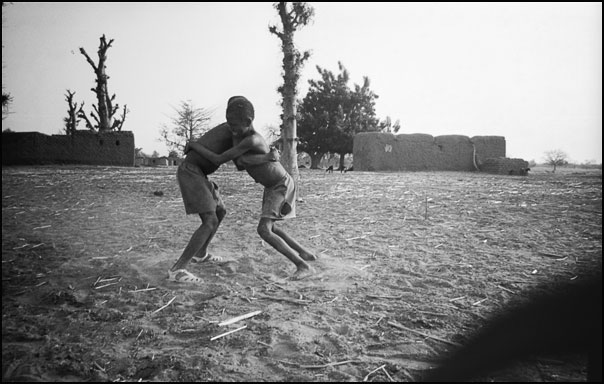
My friend Shawn Davis just sent me great story about his work with Malian kids called Visual Griots, which he explains further on his website Shawn Davis Photo.

While somewhat long, I wanted to copy an e-mail he gave me permission to paste here. We need to get this show to London!!! Thanks so much for sharing the details of the evening!


Dear friends,

It’s 1:30 in the morning and god only knows when I’ll actually fall asleep. I’m so proud of these kids and truly excited by the reaction of their parents’ generation to their photos that I am really overwhelmed. Tonight was the “soiree culturelle” organized in honor of the children’s photographs by the local NGO that AED partnered with to implement the “Visual Griots”
project in the Tominian region of Mali.

Of course we were all honored yesterday at the dedication ceremony of the new US Embassy here in Bamako, when the US Ambassador asked our students to stand and be recognized before the entire crowd (that included the Prime Minister of Mali) and then eloquently weaved Visual Griots throughout his dedication speech, as an example of a rich and rewarding collaboration between Malians and Americans.

But tonight’s event had a different impact on a very different crowd. It was a cultural evening to celebrate the success of the Visual Griots Project organized for the Bwa population of Bamako by our local NGO partner, Association Vigne. Had I done such a project with kids in my hometown in Vermont, the equivalent would be calling together all of the Vermonters living in Washington, DC to celebrate the pictures taken by the kids in small town Vermont.

The event was held in a community center or “espace culturelle” called “La Cite des Flamboyants” owned by a successful Malian mathematician originally from the same region (Tominian) as the kids we worked with. It was a beautiful outdoor space filled with plastic chairs arranged around a few mango trees and facing a stage where a local band of drummers and guitarists played traditional Bwa music between the evening’s many speeches and presentations. Above the stage was a sign that read in French “Let us all unite.” A perfect theme for this evening that was essentially connecting the villagers to the city folk of the same minority ethnic group and empowering the young villagers to bring the city folks back to their roots! There couldn’t have been two more willing parties.

It was very impressive to see how Association Vigne had leveraged the students’ photographs to raise awareness of the importance of supporting development efforts in the Tominian region, especially in regards to education. They had managed to get their Congressman to attend and speak at the event and even had official representatives from the Office of the President of Mali. All of the kids were introduced, one of them spoke briefly, and then their mayor gave a remarkable speech.

He admitted to us all that when Association Vigne suggested our photography project to them the villages had wondered what impact a bunch of photographs could have, but they thought that with foreigners involved maybe it would bring some money. “Little did we know that money couldn’t buy what this project has brought us,” he said. “These students’ photographs have brought honor upon us. We have been reminded of who we are and what we are capable of. It was an awakening. These youth have drawn the attention of our own President to our region. This is only a beginning. And for the Bwa to be represented in the National Museum of the United States is a big honor for us. And the fact the pictures are hanging in the halls of the new US embassy in Mali we are so honored. We are teaching Americans about Mali and about Africa. Let me tell you how our involvement in the Visual Griots project has already impacted education in the Yasso Commune of which I am mayor. For four years in a row the community school of Damy, a school that is organized by the villagers and maintained by the villagers, failed to present a single student who could pass the sixth grade exam and pass to the second cycle (7th grade) and move to the middle school in Yasso town. Last year, thanks to God, 20 of the 22 students who participated in the Visual Griots project in Damy and Kouara passed the exam and are now traveling from their villages every day to attend the 2nd cycle in the Yasso School. I am also proud to announce that because of this success, we submitted a request to the Malian Ministry of Education to convert the Community School of Damy into a Public School (this means government funding and support) and on October 4th we received official notice that this request was granted. Also, when the Visual Griots team did their workshop at the village school of Kouara there was only a 3-room schoolhouse. Construction is almost finished on two additional rooms for the school, as the number of children being sent by their parents to attend school is rising. I hope that you, the “Tominianers” of Bamako don’t view this evening as a token Bwa folklore event, but as an opportunity to reconnect with the land of your mothers and fathers and to support the development of the area.” (Later in the event they put a big box out into the middle of the dance floor and asked people to donate money to buy books for the school. They raised $234.50!)

Following the mayor’s speech (my personal favorite of the evening) I projected a powerpoint presentation of pictures from the workshop and of the photographs taken by the children, which elicited lots of laughter and applause from the audience. I was lucky enough to end my speech, but saying “And now I will hand over the microphone to his Excellency the President of Mali, Amadou Toumani Toure." And then I played the video clip of his visit to the exhibit of the students’ photos in the Smithsonian, including his outburst of laughter at seeing the photograph of his own election poster with his image, hanging on the wall of the student photograph’s house next to the church calendar and a couple of cowtail fly swatters. Then followed his speech, aimed directly into the journalists’ cameras, and tonight, directly into the crowd of wide-eye children and Tominianers. The President spoke of the immense courage, solidarity, and work ethic of Tominianers and congratulated them on raising their children with these values. He congratulated the children as well on their ability to capture the richness of their culture and to share it with Malians and Americans. He said that the Visual Griots project could have gone into a rich neighborhood in Bamako and come back with pictures of villas and driveways full of fancy cars, but, he added, what would these images truly represent?

At the end of the evening (in an attempt at brevity I’m skipping the part where I was not only presented with a traditional handspun cotton Bwa tunic, but dressed in it and asked to dance with the whole crowd) one of the Bamako Tominianers drove me back to my hotel in his Mercedes. “You know what ATT (their abbreviation for the President of Mali) said about the villa and the fancy car?” he said to me. “I live in one of those villas and I’m driving you to your hotel in one of those fancy cars, but I come from the place where those children’s photos were taken. I can’t walk away from seeing those photos and listening to our President . . . and not begin to think about doing something myself for my village. We the professional Tominianers in Bamako can now “faire la politique” (lobby?) so that maybe even a road can be constructed that will further the development of the region.”

This night was full of such encounters. Sure, talk is talk, but people were bursting with pride at being Bwa, they were talking to each other and lifting each other up, and it won't surprise me if it leads to other developments. I’ve never felt so lucky to be part of such a project. Honestly, tonight was probably the most fulfilling moment yet on this long road. You ask yourself all along the way about the real impact that the project will have and then you end with a night like tonight.

Benjamin Diarra, one of the older men from the school administration that helped us during the workshop back in 2005 told me tonight, “Shawn, little by little a bird builds its nest. But the bird must keep being a bird because that’s what he is. If the bird tries to be something it isn’t, if it tries to pass itself off as a frog ie’s never going to finish it's nest. So keep being yourself and working on this project and pretty soon you’ll find that you’ve built a nest and that its full of eggs.”

I'm going to sleep on that now. It's 2:50 a.m!

-Shawn

Tuesday, November 21, 2006

Africa man, original?

Preaching Free-Market Gospel to Skeptical Africa was a thought-provoking read. I suppose this debate has been reviewed for decades. But this time, I thought it was interesting that it was in the National section of the New York Times and that is again framed only as one or the other - business or charity/aid.

I wish we could get somewhere in the middle where we listen to the points Mr. Shikwati is making without seeing him as a pawn of the evil capitalist. In the same light, I wish short-sighted fiscal conservatives would stop using people like this to avoid addressing the short-comings of markets.

Sachs falls into a defensive trap yet again, which isn't helpful. Reed stikes me as a ideologue, which isn't helpful either. I think the Sachs could make headway against the ideologues of the world if they considered the criticism of the Shikwati's a bit more thoughtfully.

Mining my own business?

Mine Your Own Business will be hugely controversial as it makes us all think about the unintended consequences of blindly supporting environmentalist campaigns across the globe. It is a challenge to the green groupthink that allows westerners to deny progress to those who need it most.


Controversial indeed. For example, who would you select to play the evil environmentalist in this film?

Thursday, November 16, 2006

Going in development circles

This World Resources Institute post on Oxfam's latest report about Health, Water and Sanitation for All made me again ask myself if I think it's OK to charge for basic services such as water and basic health care.

Yes, it is OK, I think, and sometimes desirable. In places where the basic structure of tax collection and service provision do not work, you have to think outside the box and I think WRI and other blogs are pushing me to think more about well regulated business as a means to innovate and solve problems. Clearly, that shouldn’t open the flood gates to companies making a killing with basic services, but this question has to get beyond the "right" for everyone to have...health, water and sanitation. In theory, I think everyone should have these things, but it just isn't that easy. This kind of provision, if unregulated, leads to other sorts of exploitation. Certainly free aid is often diverted into commercial markets and I have heard stories of many hospitals charging just so the health workers can feed their own families. Keeping that in the shadows is like poison as the poor still don't get what they need and people who are just trying to get by end up being labeled corrupt.

What is harder to regulate, businesses with the potential to exploit or non-profits with the potential to give too much away and mix up the incentive structures? All in the tedious details, right?

I am going to read the Unilever case study from Indonesia. They were often mentioned in C. K. Prahalad's Fortune at the Bottom of the Pyramid.

Anyone with insight on this?!

Saturday, October 28, 2006

"Social enterprise" in a rut

The Financial Times can't even tell us how to define social enterprise. Last week's article, When the good struggle to be great just recycles what seems like the edge of the discussion - Interesting idea, hard to define and isn't is good people are being entrepreneurial. I personally think this confusion between social enterprise and social entrepreneur, re-told in the article, is unhelpful. One is a legal structure, the other is a person who may or may not work for a legal structure called a social enterprise. As much as I admire their ideals, Ashoka is only loosely related to social enterprise.

It would be nice to hear new ideas about how the concept of Community Interest Companies has progressed.

Thursday, October 26, 2006

Clear cutting, carbon confusion

I continue to venture into the world of "sustainable development" and all that it entails. World Business Council for Sustainable Development has some good stuff on their different rss feeds. But...

Today I learned that while some tell me that bio fuels are good (which I sometimes promote, clearly without doing all my homework), the experience of Brazil raises questions about their potential negative environmental consequences. And...

Soy, the main raw material for biodiesel in Brazil, due to its massive current production, "has already become one of the principal factors behind deforestation of the Amazon and the Cerrado, a biome of savannahs and scrub forests that covers the extensive central area of Brazil," said the expert.


All this confirmed by another article, where the World Bank is telling us that the main driver of deforestation is the consumption of cheap beef, soya, lumber and other products by the rich countries of the North.

Hold the tofu.

Oh yeah, that article tells me the answer to all these problems is..."a carbon-trading forest conservation network," which is confirmed by another article claiming that global forests are disappearing for a pittance and Kyoto is the answer.

Clearly I am not getting too many answers from my exploration of this website. Let's ask the academic in my house...

Alberto says, "the important things to remember are environmental narratives and social constructivism, which teach us that it's not about what these articles say, but who is talking and why." He's clearly smart, but as a professionally and personally interested person, today I can understand why some people just can't be bothered.

Tuesday, October 24, 2006

'You Internalize It in Your Gut'

Huge congratulations to Millie Ravenel, director of University of North Carolina's Center for International Understanding, and her colleagues for re-prooving one of the most underutilized tools of social change: socializing! Travel to listen, learn and try to see things from the other side.

There are two great pieces featured on National Public Radio on the way Americans on both sides of the immigration debate had transformative experiences when they took a week-long trip to Mexico to better understand why people actually immigrate to the US.

I think this process has profound potential. It always has. As a former Peace Corps volunteer from Russia who grew up in the 80s under the nuclear-armed thumbs of Reagan and Gorbachev, I too had some serious "aha" moments when I met my peers from the "evil empire."

Taking it one step further, how about a study tour to Egypt, Saudi Arabia or even Iran for Americans? Every Westerner I know who's been there says they felt Iran was one of the friendliest countries they have ever visited. Why not?!?!

Sunday, October 22, 2006

Diamond CSR, or not...

NPR's piece on the up coming movie "Blood Diamond" reminded me of a recent website created by the diamond industry, Diamond Facts. I admit it is poorly named, particularly since the "facts" are "sourced from" the likes of De Beers Group and the Gem and Jewellery Export Promotion Council. Why don't they attribute a fact to its direct source?

What I appreciate about the Diamond Facts website is that it does help people understand some of the issues at stake. It doesn't mean consumers should be any less vigilant and I certainly question some of their sourced facts from the diamond industry. But at least one can learn about the Kimberly process. I do think the companies are in a tough spot as they working in extremely difficult political environments.

But why didn't Diamond Facts have a link to Global Witness?

Read this gripping story on Diamonds, children and witchcraft and if you think Diamond Facts might need a slight change in it's presentation. Also another BBC story from the Central African Republic.

Saturday, September 16, 2006

Un-sustained blogging to change!

Well, blogging hasn't been my forte in recent weeks. Time to renew efforts, blah, blah, blah...

I have taken on new work in the realm of "sustainable" development. Much to learn, but still closely linked to the ideas I have been thinking about. One recent article I was reading made a sharp observation: "The truth is that sustainability implies something quite different depending on which wide of the bulldozer you are on."

Approaching my work with healthy skepticism, I have also recently enjoyed a nice story for kids...about development and destroying cultures in the name of development. Kids grow up quickly these days.

Enjoy There You Go! from Survival International.

Tuesday, June 13, 2006

Peer to peer development

In case one hasn't read the story of Kiva yet, there is a good interview on the World Resources Institue website about this innovative peer-to-peer microloan program.

Going forward, we believe that facilitating connections is going to be our "bread and butter", so we are trying to create software, a platform which will continuously create those synergies without us getting much involved. We don't want to create the connection or manage the connections, we want to facilitate them and then get out of the way.


The Kiva model pushes the imagination and makes me wonder if it would be possible to do more to maintain and strengthen connections beyond just giving a loan. My favorite "connection" recently has been the Nata Village Blog, which I follow regularly.

Friday, May 26, 2006

Easterly versus Sachs (and Bono)

I have been meaning to write something (and compile links) on the recent debate about international development between William Easterly and Jeffery Sachs.

After $2.3 trillion over 5 decades, why are the desperate needs of the world's poor still so tragically unmet? Isn't it finally time for an end to the impunity of foreign aid?


With that, you have the basic questions Easterly is posing to Sachs and development practitioners.

I will not hide my bias. I largely agree with Easterly's opinion that Sachs is overly interested in "poverty traps" and increasing aid levels in order to duplicate his model villages. But I would prefer if these economists worked together. Tragically, the problems they want to solve have no easy answers and some have misused critical analysis to oversimplify and sensationalize and difficult issues. (See this horrible clip from ABC news.)

For a concise overview of Easterly's book, The White Man's Burden, I recommend the online exchanges hosted by the Cato Institute and Easterly's own website, which links to many of the book's reviews, good and bad. If you only have time for one review, Amartya Sen's is especially thoughtful, as is Easterly's response.

I think Easterly is bringing up some crucial problems in the way international development is framed and presented. I applaud Sachs and Bono for raising awareness about global poverty, but I just do not think development happens with more money and we certainly can't spend away poverty as Bono's Red campaign is encouraging us to do. I am thrilled Bono's work will raise cash for the Global Fund to Fight AIDS, Tuberculosis and Malaria, but it doesn't engage sufficiently with the issues Easterly is bringing to our attention.
What I most appreciate about Easterly's book is his emphasis on the incentives making development work (or not). The challenge of incentives struck me again on Sunday while reading the newspaper. On page 26 was a story about Bono’s tour of Southern Africa. On page 34 was a story about the exodus of Kenyan nurses to Europe and the US. Their search for a better life has left many hospitals in a staffing crisis. Bono's trip may increase the likelihood that more people will give to the Global Fund. But it is the small and serious problems (like fleeing nurses) that are not being addressed by our spending sprees, even if world governments cough up as much money as they promise.

Monday, May 15, 2006

All information, all the time.

Great read in the NY Times magazine on books, networks and the future of it all. Here!

From the days of Sumerian clay tablets till now, humans have "published" at least 32 million books, 750 million articles and essays, 25 million songs, 500 million images, 500,000 movies, 3 million videos, TV shows and short films and 100 billion public Web pages. All this material is currently contained in all the libraries and archives of the world. When fully digitized, the whole lot could be compressed (at current technological rates) onto 50 petabyte hard disks. Today you need a building about the size of a small-town library to house 50 petabytes. With tomorrow's technology, it will all fit onto your iPod. When that happens, the library of all libraries will ride in your purse or wallet — if it doesn't plug directly into your brain with thin white cords. Some people alive today are surely hoping that they die before such things happen, and others, mostly the young, want to know what's taking so long. (Could we get it up and running by next week? They have a history project due.)


As someone who just received The Complete New Yorker for Christmas, a gift that allowed me to purge my hardcopy storage of back issues, I love this idea in theory. But, honestly, having it on my computer is not the same as taking a copy to the park. Flipping through pages still has an appeal to me. Making notes in the margins that I will discover, unexpectedly, years later ensures a future surprise. I know the interface is trying to duplicate these simple pleasures, but I am not sold yet even if I feel like I am swimming against the unyielding current of change.

And I can't help but think of Winston Smith, protagonist from 1984 (available online, of course). What happens when someone begins to control or tamper with this digital library?

And I can't help but wonder about...let's call them... "misconceptions" that are written down? Will all information, all the time and all at the click of a button push forward the negotiating process in the Middle East or other historical mine fields? I guess disputes will generate this message: The neutrality and factual accuracy of this article are disputed.

And a million other questions too!

Kevin Kelly's conclusion: "In the clash between the conventions of the book and the protocols of the screen, the screen will prevail."

To be continued...

Technorati Tags:

Saturday, May 13, 2006

Blogs 101

Glad to see the NY Times embracing the blog world and helping people figure it out with a short Blogs 101.

I am reading as many "intros to blogging" as possible. I am also watching my news consumption change before my eyes.

Friday, May 12, 2006

(Bad) democracy rising!

This is thought-provoking stuff. Open Democracy gives a monthly bad democracy award. I am entertained by this month's options since there are two leaders this month from the areas I have worked in recently (the South Caucasus). I thought Misha Saakashvili was the leader of the Rose Revolution, which is supposed to be a shinning example of all that's going well in the region. Who can you trust these days?

Be honest and only vote once!

Tuesday, May 09, 2006

A sharp CSR debate!

Whole Foods has reprinted a Reason Online double-team on its CEO John Mackey by Nobel laureate Milton Friedman and Cypress Semiconductor's T. J. Rodgers. The topic is corporate social responsibility and a whole lot more.

These gentlemen are way smarter than I will ever be, but the exchange (at least the one between Mackey and Friedman) seems to be a rhetorical argument where there are simply hard-to-quantify intangibles like purchasing goodwill and consumer loyalty. Whole Foods pays an arbitrary 5% of profits on certain days throughout the year. Mackey calls it social responsibility and Friedman, I think, calls it self-interest. I call it "enlightened self-interest" and I would like to see it grow.

I don't appreciate T. J. Rogers tone. He seems to forget that corporations can export externalities and costs that investors can't see. Yes, a bank that practices predatory lending to low-income areas, a gun company that sells assault weapons abroad in war-torn hell holes and oil companies that fight efforts to increase fuel-efficiency may be upstanding corporate leaders making high return on investment within the law, but the costs of their trade hurt.

In my humble, humble opinion, Mackey wins the debate!

Wednesday, May 03, 2006

Social (journalism) enterprise, I guess...

In an effort to understand the UK's concept of "social enterprise" - a business with primarily social objectives whose surplus is principally reinvested for that purpose in the business or in the community, rather than being driven by the need to maximize profit for shareholders and owners. (Social Enterprise - A Strategy for Success, DTI, 2002) - I heard an interesting piece on NPR about a newspaper in Alabama.

The word social enterprise isn't used in the story. The publisher wants to create a not-for-profit and the "earnings will be used to run the paper, and its dividends will help pay the cost of teaching the students."

I have two main questions: 1) Is it necessary to create the organizational distinction for "social enterprise" or, the new legal term, Community Interest Companies (CICS)? It doesn't seem to be an active debate in the US. 2) Is this a dying hope that an enterprise can survive with the added social benefit (or business cost) of working with less experienced professionals?

There seems to be something the UK is trying to develop by promoting CICS that goes beyond the traditional non- and for-profit models.

It is the duty of a newspaper to become the attorney for the most defenseless among its subscribers. 'Anniston Star' philosophy, Col Harry M. Ayers

I hope they succeed. Haven't heard this kind of sentiment for a long time...

Monday, May 01, 2006

Fancy a blog?

Does fully embracing the 21st century mean having a blog of one's own? NPR's Scott Simon seems to think his would be boring because he's short of time. He better find the time, 'cause to be truly 21st century, he needs to write about eight blogs, read about .0001% of the 30 Million out there and keep his MySpace profile hip, cool and super sexy. He doesn't even seem to have a MySpace profile yet.

How long will newspapers write this story? How long will I blog about it?

Sunday, April 30, 2006

Critical dissident

I am trying to pay more attention to Russia and did a double take reading a Guardian piece on Alexander Solzhenitsyn. I have tended to find the former-dissident and writer a bit too apologetic on Russia's slide toward illiberal democracy. But a passage made me think:

At a time when American and European officials are repeatedly questioning Mr Putin's commitment to democracy, Solzhenitsyn said: "Present-day western democracy is in a serious state of crisis." He said Russia should not "thoughtlessly imitate" these democracies but look after its own people.


He might be on to something...

Yesterday's interview touched on a burning issue in Russia, that of the growing xenophobia that has led to dozens of attacks on foreigners so far this month, at least six of which were fatal. He warned against condemning all nationalism: a little was needed, he said, to stop ethnic Russians from dying out.


For me, Solzhenitsyn's observations are a reminder of why being consistent matters. As the article highlights, the West's support of democracy in Russia and the Newly Independent States was inconsistent at the very best. I see a connection between his (self-) defense of Russia and various current geopolitical policy debates. Too much moralizing about democracy without consistent action leads many to mistrust...or worse.

Wouldn't it be good if one of the bravest voices against oppression was on "our" side?

More thoughts on the "hypocrisy of international allegiances" and why you punish Belarus, lunch with Azerbaijan and bring out the pipers and drummers for China from Friday's Guardian.

Monday, April 24, 2006

Who you tryin' to fool?

While I missed it when it first came out, The Economist survey on corporate social responsibility from Jan. 2005 is useful for telling us that just because a company uses do gooding language doesn't mean they do good. And there is some useful distinctions between irresponsible corporate PR tricks and genuine philanthropy. Certainly, CSR gets used for lots of dubious reasons. But do they really expect me to believe this statement?

By and large, the world is not running out of resources; where it is, prices reflect that fact. As a result, the ordinary pursuit of profits is an excellent guide to companies on whether to recycle.


The survey would have us believe that pursuit of profit and adherence to existing legal and regulatory frameworks is enough. This totally ignores the problem of collective action and the influential power of corporate giants to manipulate those of us with limited time to understand what's really happening.

I have found past articles from the Stanford Social Innovation Review more enlightening about the debate. The Myth of CSR highlights the weaknesses without making us think responsible business is only for naive idealists and Changing the Game provides some convincing examples of how doing more can be smart for business. I like to think there is a growing market for responsible business, even if it makes me a naive idealist.

I think these issues are challenging and timely. New campaigns like Product RED are encouraging us to consume to help fight HIV. It seems to raise awareness and generate funds for a good cause, but I begin to worry when we think we can consume ourselves out of social problems.

Thursday, April 06, 2006

Check out the latest blog

RSS feeds and other cool tools in the Web 2.0 world have a way of both empowering and diluting any sense of power I may sometimes feel. With RSS, I can monitor headlines from everywhere, yet after a few articles here, a blog there and a few more headlines for good measure, and I feel like I haven't gotten anywhere, mostly since each online story leads down another path to new blogs that I was a fool for missing until today. Growing pains of an Internet user, I guess. I don't quite recall feeling this way when I didn't read the newspaper every morning.

Foreign Policy started a new blog a few days ago. It seems great that now I can be privy to "arguments hashed out at the coffee machine, editors' insights on the news, story tips buried on their desks, things they hear from their friends abroad, and interesting links that circulated through their inboxes."

High speed Internet allows me to listen to my favorite NPR news shows online throughout my London flat and more and more shows are interviewing personalities from the blogging world. Almost daily I am informed about another blog site that's independent, dynamic and all the rage. Is there no end? Isn't this the beauty of the new technology? There is no end! But what I am finding is that many sites are following a similar pattern with similar ideas.

I want a cool tool that knows me intimately, knows my sense of humor and my passions. A tool that can tell what I am curious about and then gives me a nice, neatly edited page with the things I need to know. I think this tool must be locked in my brain somewhere. If only I could find it!