Showing posts with label africa. Show all posts

Tuesday, August 04, 2015

Re-writing History -- Kenya and Beyond

This Radio Lab story on the Mau Mau rebellion in Kenya and British response is gripping. It seems like Radio Lab was a bit late getting the story since the importance of Hanslope Park, where the documents were stored, was discussed years ago.  But it appears from this article in Feb. 2014 that it will be a while before anyone learns much more...
Since its existence was quietly made public in 2012, the FCO has twice had to seek a special 12-month dispensation from the Justice Secretary, Chris Grayling, while it decides how much of the archive to declassify. The department announced in December that it will spend six years assessing 60,000 files from the archive, kept at Hanslope Park, near Milton Keynes and classified as "high priority".
The Radio Lab programme has an interesting section on why these documents were saved. Apparently, one idea is that Edward Snowden-esque people opposed the wrongs they witnesses and wanted to save the evidence in hope that the world would eventually find out.

Thursday, April 24, 2014

Power of Reconciliation

Such an amazing story and project about perpetrators and victims from the Rwandan genocide.


See all the photos and stories here.

Friday, May 25, 2012

Saving Tigers

Potlatch is very observant and I wish I could condense this whole post into a statement that can be said in the time it takes to dodge the people trying to get my signature on the street. Perhaps "That's Not How Tigers Die!" will become the code word for all his points.

And I haven't heard from Kony 2012 recently, but they are still dancing. I am pleased to see they are keeping their work going, and it's good news that a leader has been captured, but does it have to be so strobe lighty and rave-crazed? "That's Not How Tigers Die!"

Friday, March 09, 2012

More Thoughtful Responses On Kony 2012

On Complexity, Awareness, and Social Action
What I am advocating for is that before you take action you dig deeply into the issue before pushing people with political power to use international force in a nation and continent not your own. That is not a flippant decision to make. And to do so based on emotion or slick marketing is socially irresponsible. You may decide, as other thoughtful people have, that doing so is what is necessary, but please do so realizing that it should be a last resort.
(Note, this blog started with a commitment to complexity.)

And via McCarty's blog, this comment by Mr. Okwonga in The Independent is an important comment on the whole issue. He writes:
Invisible Children asked viewers to seek the engagement of American policymakers and celebrities, but – and this is a major red flag – it didn’t introduce them to the many Northern Ugandans already doing fantastic work both in their local communities and in the diaspora. It didn’t ask its viewers to seek diplomatic pressure on President Museveni’s administration.

And one from the ever-insightful Knowledge Management 4 Development (KM4Dev) listserv: KONY2012 – a story in one flavour

This linked me to a great video by Chimamanda Adichie on TED about "one story". And her talk reminds me of a very formative paper I read by Richard Shweder, "Moral Maps, 'First World' Conceipts, and the New Evangelists". In it, he writes:
...I am a cultural pluralist. My version of cultural pluralism begins with a universal truth, which I refer to as the principle of "confusionism". A "confusionist" believes that the knowable world is incomplete if seen from any one point of view, incoherent if seen from all points of view at once, and empty if seen from "nowhere in particular". Given the choice between incompleteness, incoherence, and emptiness, I opt for incompleteness while staying on the move between different ways of seeing and valuing the world.

And one more that I read via Mr. Thorpe's post: Kony 2012: history, nuance, and advocacy’s Golden Rule

Thursday, March 08, 2012

Exaggerating Truth To Be Effective?

...and another thing...

I was reminded of another video that got me a bit unsettled last year. I refreshed my memory and came across another thoughtful piece in The Guardian: Unwatchable: should charities use shock tactics to get attention?

It speaks about when it is and isn't OK, in the writer's opinion, to exaggerate, shock and make the general public uncomfortable. I'd guess there will never be a right answer to this. I agree with this statement: "Sometimes it can be tempting to prioritise effectiveness over truth. I know of campaigns that have deliberately exaggerated statistics and claims to provoke a reaction. It has sometimes worked, but in the long-term an untruthful strategy may well lose support and legitimacy."

How you convey "the truth" matters. In my last post on Kony 2012, I guess I was saying that I didn't like their message, but it provoked me to act (not buy posters, but get to work in my own way).

The makers of "Unwatchable" state:
We know we’ve made something which many are going to find disturbing and thought it was important to explain why we went to such lengths. The issue that hundreds of thousands are targeted by weaponised rape as a tactic of destroying communities to control mines has been with us for over a decade and still continues.

The last sentence doesn't answer an important question: who is using rape as a weapon? So the awareness-raising "truth" will make people more anti-mining rather than think about who uses rape and why they are able to get away with it. Mining companies have a huge responsibility to prevent their complicity, but the truth is that such violence doesn't just disappear if you even could set up a programme to mine only "rape free" minerals so tossing out your iPhone won't do anything. In short, this is a less effective campaign than Kony 2012, in my opinion, especially as it makes people less open to thinking about ways that natural resources present an opportunities for development.

And, the assumption that if you see wealthy white people getting raped means we should care seems like an "effective" tactic, but makes my stomach turn. Maybe that's just my displeasure with the way of the world rather than a comment on the film.

This video on "Why we made this?" is really worth watching. But I still don't change my opinion. And if you ask me, nothing can be more horrific than the story itself, told in graphic detail with no professional directors and filmmakers.

Kony 2012

Holy Thursday morning distraction! I must blog!

The buzz around Kony 2012 reached my inbox early, encouraging me to drink even before lunch. I watched the film -- I cried a bit, rolled my eyes a lot and felt old for not being able to socially network like my younger socializing friends. Mixed emotions.

I've got no major problem with the filmmakers. I think it's naive. But I value and respect what it takes to organize. I also value the tone of their responses to the criticism. Dialogue is good and they are responding in detail to their weaknesses and inviting you/me to ask harder questions.

At the end of the day, I really value the push of encouragement at the end of this post -- go and read the Crisis Group analysis from November about this problem! If 1% of the 26,684,765 people who see the film on youtube do that (and go further still), that's a lot of better informed people on a really complex issue.

If some naive guy wants to push for the urgency of now, it may make me cringe on many, many levels, but I was "there" once too and I did far less than him to try and raise awareness. More power to him. Maybe in the buzz of outcry against and outcry to support, we'll all get a bit more creative about how to deal with the complexity. The the fatigue that comes with dealing with complexity is real, it's not going away, so I appreciate the kick in the pants. In fact, all this stuff is even making me re-think Bono, who I have long criticised for his shallow and over-simplistic approach to social change. But Bono is making a case that often leads to better, more specific critiques of aid and development. So, well done, Bono (even if I think your music is still shit).

Here's to all the over-simplifies, even you Bono! And to everyone who knows it's more complex, use your disgust at the over-simplification as a new push to get more creative at making your solutions heard.

Wednesday, June 23, 2010

I Had A Farm In Africa

Social change, for sure, but to what end? I just watched When China Met Africa, a short film with no commentary. Just images and exchanges. Very intense images.

A historic gathering of over fifty African heads of state in Beijing reverberates in Zambia where the lives of three characters unfold.

Mr Liu is one of thousands of Chinese entrepreneurs who have settled across the continent in search of new opportunities. He has just bought his fourth farm and business is booming.

In northern Zambia, Mr Li, a project manager for a multinational Chinese company, is upgrading the country's longest road. Pressure to complete the job on time intensifies when funds from the Zambian government start running out. Meanwhile, Zambia's trade minister is en route to China to secure millions of dollars of investment.

Through the intimate portrayal of these three characters, the expanding footprint of a rising global power is laid bare - pointing to a radically different future not just for Africa but also for the world.


Available until July 22, 2010.

Sunday, May 16, 2010

Randomizing Hits The New Yorker

"The Poverty Lab" in the May 17 New Yorker brings aid effectiveness further to the public discussion. It is a profile of Ester Duflo, who is one of the co-founders of the Poverty Action Lab.

TED presentation on social experiments too. Largely an intro into randomized trials.

I don't think the article's selected metaphor from Angus Deaton is really substantial. It recalls his powerpoint presentation with two people jumping out of an airplane, one with a parachute and one without - Do we need to test the idea that parachutes are useful to people who jump out of planes?

Over simplistic. I like Duflo's response to Deaton's criticism of randomized trials tendency to generalize.

"We are not just evaluating a program and attaching some larger thoughts at the end, but finding ways to use evaluation to explore theories."

By explore theories, I understand this to mean "challenge assumptions", which is really useful, albeit not as prone to silver bullet solutions and sexy campaigns that make rock stars out of economists and vice versa.

Wednesday, February 25, 2009

Dambisa Moyo and "Dead Aid"

Yes, not secret that I am not a fan of Bono (neither his music nor work on aid effectiveness). But I fear the arrival of "Dead Aid" isn't going to help stimulate the debate in a good way.

The author, Dambisa Moyo, makes some good points in the interviews I have read and heard. And she's right to call on African countries to innovate during the financial crisis. But it isn't so black and white and while her critique needs to be considered very carefully in any effort to improve aid effectiveness, calling for an end to aid in Africa in "five years" is just irresponsible. Some aid keeps people alive. That doesn't mean the points are not valid, but I worry that Moyo's conclusions will only polarize.

While I appreciate her plug for www.kiva.org, that's only one solution that needs to be used and it isn't enough, which I trust even Kiva would admit (though I do hope they get more donations as a result of her work!). Kiva cannot reach some of the poorest people as a result of poor infrastructure and bad or non-existent governance. So, we have to demand that aid changes, not demand that it stops completely. Even Moyo admits, "it is not to say there are not some good aid projects on the ground", in this interview.

And she's wrong when she claims there is "nobody" who feels sorry the poor in China. I feel sorry for the 300 million Chinese people who live in substandard conditions and a lot of others do as well. We just don't here about them as much due to many factors beyond the topic of this post.

More and more, I find myself agreeing with Paul Collier. Here's his review of Moyo's book.
I think that African societies need international help to overcome these problems; it is just that the help they need is not predominantly money. Aid is not a very potent instrument for enhancing either security or accountability. Our obsession with it has detracted from the more important ways in which we can promote development: peacekeeping, security guarantees, trade privileges, and governance.

Monday, February 02, 2009

"Army Worms" Sounded Bad Enough

As if this story couldn't get any more horror movie-ish..."Pests that have ravaged crops in Liberia and sparked a national emergency, while threatening other countries in West Africa, are not army worms and remain unidentified, the ministry of agriculture said on Monday."

Friday, February 01, 2008

"Malaria and How to Beat It"

The debate on giving away free malaria nets (and other health interventions) continues in The Economist. Now the WHO is backing the drive to kill the notion that paying a small amount makes a greater impact.

I am a bit confused in my own logic on this one. The Economist saying give it away, while I am intuitively feeling like "free is more effective" still ignores a few key points. Maybe the simple lesson is summed up best by hwig, a commenter on the article...
Giving out free nets is fine but it should be accompanied by a strong program of education otherwise they will be misused in exactly the way described at the beginning of the article.
Is that right?

Update March 24, 2008: A few more comments on the matter from the PSD blog, which has a link to the WRI post that has commentary on the issue.

Thursday, November 08, 2007

Still my favorite blog!


Congrats to Kedibonye Elijah, winner of the HIV essay contest, and especially to the two creators of Nata Blog. What an amazing model for getting support and sharing your stories.

C.A.R. Blog?!?

This is leap-frogging at its best! Kudos to the Humanitarian and Development Partners - Central African Republic for a Web 2.0-charged blog and intranet for Humanitarian and Development agencies. I learned about it from friend and was gutted to have missed the presentation of Tony Lanzer at the LSE. You can still see the presentation online with power point.

Everyone should learn a little bit about CAR..., but somewhat only an aid story. More on that later.

Wednesday, November 07, 2007

More on mosquito economics

To subsidize or not to subsidize, isn't that always the Economist's question? It was in Money v mosquito, asking whether the Gates Foundation and World Bank should subsidize a malaria remedy to keep the price down.

(Has anyone else noticed that when you wish to blog about something, you end of finding five more things you should read?)

Wednesday, September 12, 2007

Steve Biko

The BBC had a link that caught my eye - it has been 30 years since the death of Steve Biko, the South African leader of black consciousness. Seems a bit narrow as he helped me learn a lot about being conscious in general. I learned about Biko while reading My Traitor's Heart, one of my favorite books for too many reasons to name here. Highly recommended!

Wednesday, April 18, 2007

Coffee trade and intellectual property

The value of a brand or a manufacturing license is now far more important than a product’s physical production. Also, income from creative products (such as designs, writings or inventions) is entirely due to intangible value.

So reports the Light Years IP website, which today launched a blog on its project with Ethiopian Coffee growers. The blog will give "real-time coverage as they lead a momentous training on Intellectual Property management, bringing together fine coffee stakeholders from across Ethiopia."

This case seems to need a whole econ course. If you talk to Starbucks, the seem to think they have done a lot to help coffee and Ethiopia. If you get the other sides, Starbucks is little more than a greedy corporation. Of course, the Economist warns us of the side effects of fair trade initiatives:

Starbucks also has questions about the different standards of fairness applied by the Fair Trade brand custodians in different parts of the world. It doubts even that the strategy of the Fair Trade movement, to secure farmers a premium over the market price for their beans, is the best basic approach. Starbucks prefers a code known as the CAFE practices (Coffee and Farmer Equity), which aims to help coffee farmers develop sustainable businesses through a mixture of technical support, microfinance loans, and investment in infrastructure and community development where the farmers live.

No opinion here. But I am eager to hear a bit more from the directly affected people rather than another press release from Starbucks or an NGO working on fair trade. Perhaps the Light Years IP blog will give some insight. I will also be reading through the Poor People's Knowledge, that includes a chapter by the founders of Light Years IP. This seems like an idea worth exploring.

Friday, March 30, 2007

Still my favorite blog...


The Nata Village blog remains one of my favorites. I like checking in from time to time...today I was inspired by the exchanges that are beginning with schools from North America that have picked up on this and are beginning to have their students read about Botswanna.
Despite the hardships here, kids still figure out a way to have fun. The boys in the photo are big fans of the Zebras. The Zebras are the national football (soccer) team of Botswana. Whenever the Zebras play, everyone gets excited about it and the kids show their spirit by painting their chins the team colors. We are pleased that kids in the developed world are opening their minds to the hardships of others. The teachers are doing a fantastic job of educating their students.

Thursday, December 14, 2006

Holy shit moments...

Every now and then, something in the media makes me say "holy shit" and today I had one reading a story on Somalia's current and potentially widening conflict.
"I am ready to die," said Osama Abdi Rahim, dressed head to toe in camouflage and marching around with a loaded rifle. He is 7 years old.

Holy shit.


Photo by Joao Silva

Monday, November 27, 2006

Visual Griots

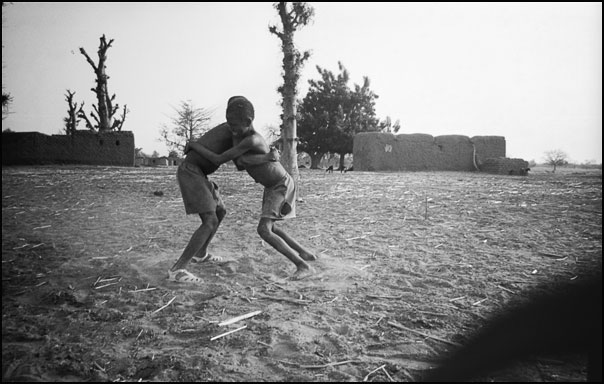
My friend Shawn Davis just sent me great story about his work with Malian kids called Visual Griots, which he explains further on his website Shawn Davis Photo.

While somewhat long, I wanted to copy an e-mail he gave me permission to paste here. We need to get this show to London!!! Thanks so much for sharing the details of the evening!


Dear friends,

It’s 1:30 in the morning and god only knows when I’ll actually fall asleep. I’m so proud of these kids and truly excited by the reaction of their parents’ generation to their photos that I am really overwhelmed. Tonight was the “soiree culturelle” organized in honor of the children’s photographs by the local NGO that AED partnered with to implement the “Visual Griots”
project in the Tominian region of Mali.

Of course we were all honored yesterday at the dedication ceremony of the new US Embassy here in Bamako, when the US Ambassador asked our students to stand and be recognized before the entire crowd (that included the Prime Minister of Mali) and then eloquently weaved Visual Griots throughout his dedication speech, as an example of a rich and rewarding collaboration between Malians and Americans.

But tonight’s event had a different impact on a very different crowd. It was a cultural evening to celebrate the success of the Visual Griots Project organized for the Bwa population of Bamako by our local NGO partner, Association Vigne. Had I done such a project with kids in my hometown in Vermont, the equivalent would be calling together all of the Vermonters living in Washington, DC to celebrate the pictures taken by the kids in small town Vermont.

The event was held in a community center or “espace culturelle” called “La Cite des Flamboyants” owned by a successful Malian mathematician originally from the same region (Tominian) as the kids we worked with. It was a beautiful outdoor space filled with plastic chairs arranged around a few mango trees and facing a stage where a local band of drummers and guitarists played traditional Bwa music between the evening’s many speeches and presentations. Above the stage was a sign that read in French “Let us all unite.” A perfect theme for this evening that was essentially connecting the villagers to the city folk of the same minority ethnic group and empowering the young villagers to bring the city folks back to their roots! There couldn’t have been two more willing parties.

It was very impressive to see how Association Vigne had leveraged the students’ photographs to raise awareness of the importance of supporting development efforts in the Tominian region, especially in regards to education. They had managed to get their Congressman to attend and speak at the event and even had official representatives from the Office of the President of Mali. All of the kids were introduced, one of them spoke briefly, and then their mayor gave a remarkable speech.

He admitted to us all that when Association Vigne suggested our photography project to them the villages had wondered what impact a bunch of photographs could have, but they thought that with foreigners involved maybe it would bring some money. “Little did we know that money couldn’t buy what this project has brought us,” he said. “These students’ photographs have brought honor upon us. We have been reminded of who we are and what we are capable of. It was an awakening. These youth have drawn the attention of our own President to our region. This is only a beginning. And for the Bwa to be represented in the National Museum of the United States is a big honor for us. And the fact the pictures are hanging in the halls of the new US embassy in Mali we are so honored. We are teaching Americans about Mali and about Africa. Let me tell you how our involvement in the Visual Griots project has already impacted education in the Yasso Commune of which I am mayor. For four years in a row the community school of Damy, a school that is organized by the villagers and maintained by the villagers, failed to present a single student who could pass the sixth grade exam and pass to the second cycle (7th grade) and move to the middle school in Yasso town. Last year, thanks to God, 20 of the 22 students who participated in the Visual Griots project in Damy and Kouara passed the exam and are now traveling from their villages every day to attend the 2nd cycle in the Yasso School. I am also proud to announce that because of this success, we submitted a request to the Malian Ministry of Education to convert the Community School of Damy into a Public School (this means government funding and support) and on October 4th we received official notice that this request was granted. Also, when the Visual Griots team did their workshop at the village school of Kouara there was only a 3-room schoolhouse. Construction is almost finished on two additional rooms for the school, as the number of children being sent by their parents to attend school is rising. I hope that you, the “Tominianers” of Bamako don’t view this evening as a token Bwa folklore event, but as an opportunity to reconnect with the land of your mothers and fathers and to support the development of the area.” (Later in the event they put a big box out into the middle of the dance floor and asked people to donate money to buy books for the school. They raised $234.50!)

Following the mayor’s speech (my personal favorite of the evening) I projected a powerpoint presentation of pictures from the workshop and of the photographs taken by the children, which elicited lots of laughter and applause from the audience. I was lucky enough to end my speech, but saying “And now I will hand over the microphone to his Excellency the President of Mali, Amadou Toumani Toure." And then I played the video clip of his visit to the exhibit of the students’ photos in the Smithsonian, including his outburst of laughter at seeing the photograph of his own election poster with his image, hanging on the wall of the student photograph’s house next to the church calendar and a couple of cowtail fly swatters. Then followed his speech, aimed directly into the journalists’ cameras, and tonight, directly into the crowd of wide-eye children and Tominianers. The President spoke of the immense courage, solidarity, and work ethic of Tominianers and congratulated them on raising their children with these values. He congratulated the children as well on their ability to capture the richness of their culture and to share it with Malians and Americans. He said that the Visual Griots project could have gone into a rich neighborhood in Bamako and come back with pictures of villas and driveways full of fancy cars, but, he added, what would these images truly represent?

At the end of the evening (in an attempt at brevity I’m skipping the part where I was not only presented with a traditional handspun cotton Bwa tunic, but dressed in it and asked to dance with the whole crowd) one of the Bamako Tominianers drove me back to my hotel in his Mercedes. “You know what ATT (their abbreviation for the President of Mali) said about the villa and the fancy car?” he said to me. “I live in one of those villas and I’m driving you to your hotel in one of those fancy cars, but I come from the place where those children’s photos were taken. I can’t walk away from seeing those photos and listening to our President . . . and not begin to think about doing something myself for my village. We the professional Tominianers in Bamako can now “faire la politique” (lobby?) so that maybe even a road can be constructed that will further the development of the region.”

This night was full of such encounters. Sure, talk is talk, but people were bursting with pride at being Bwa, they were talking to each other and lifting each other up, and it won't surprise me if it leads to other developments. I’ve never felt so lucky to be part of such a project. Honestly, tonight was probably the most fulfilling moment yet on this long road. You ask yourself all along the way about the real impact that the project will have and then you end with a night like tonight.

Benjamin Diarra, one of the older men from the school administration that helped us during the workshop back in 2005 told me tonight, “Shawn, little by little a bird builds its nest. But the bird must keep being a bird because that’s what he is. If the bird tries to be something it isn’t, if it tries to pass itself off as a frog ie’s never going to finish it's nest. So keep being yourself and working on this project and pretty soon you’ll find that you’ve built a nest and that its full of eggs.”

I'm going to sleep on that now. It's 2:50 a.m!

-Shawn